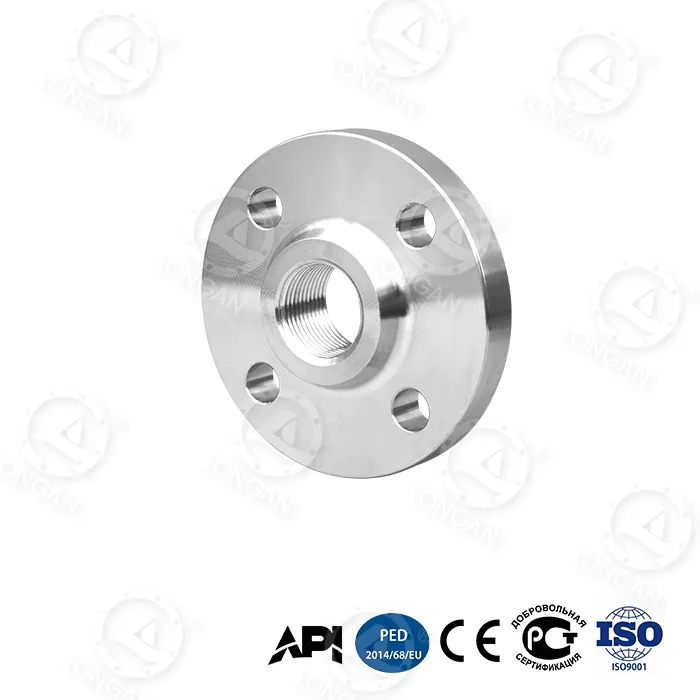
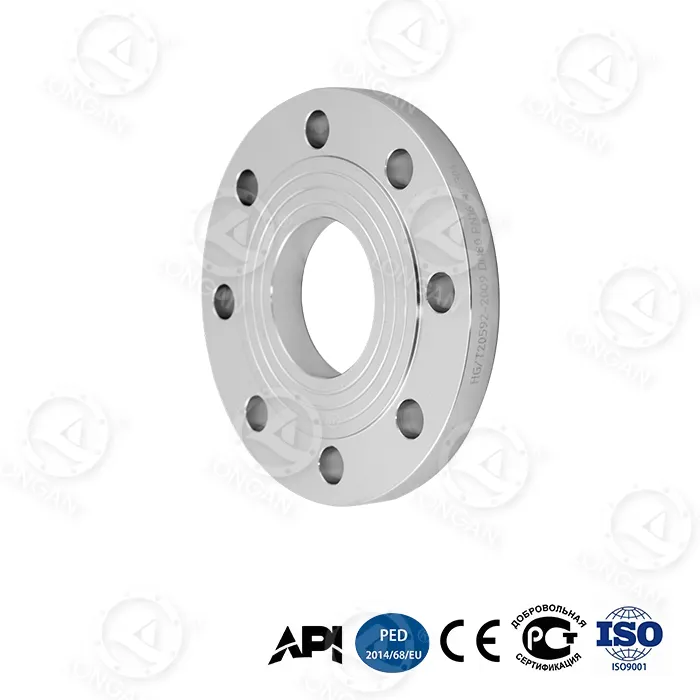
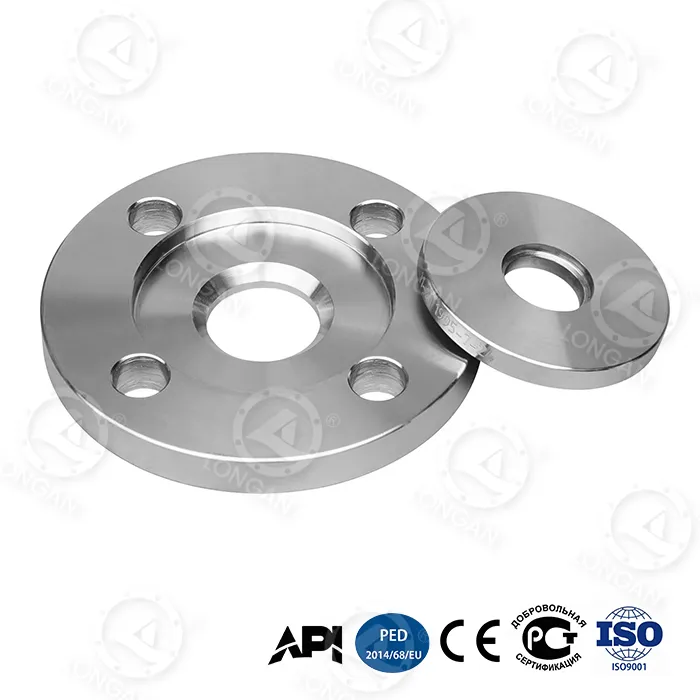
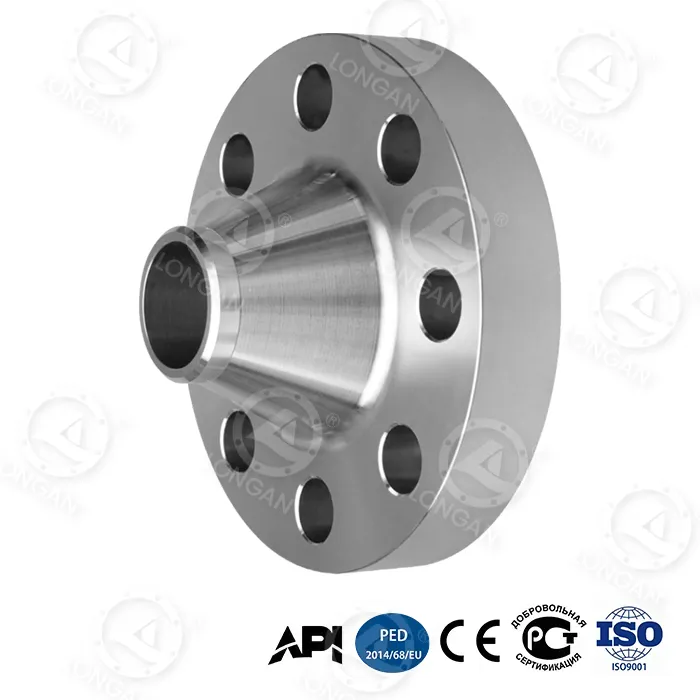
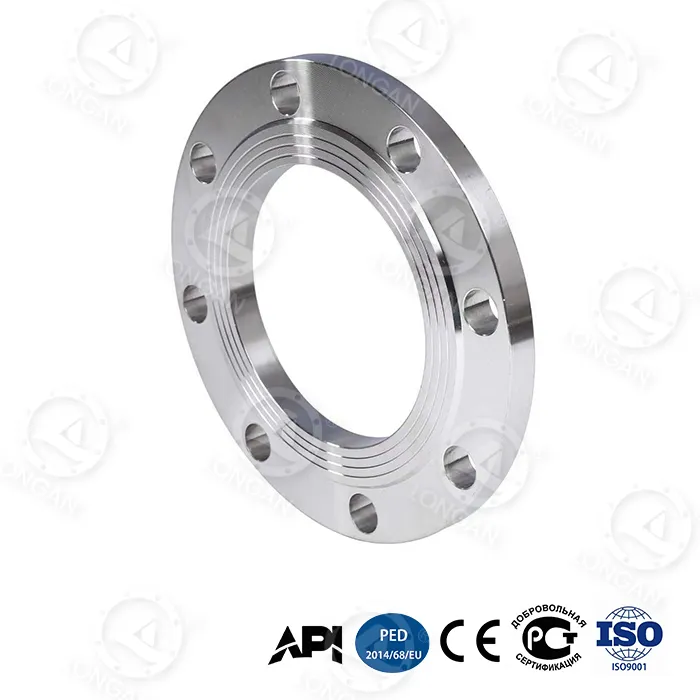
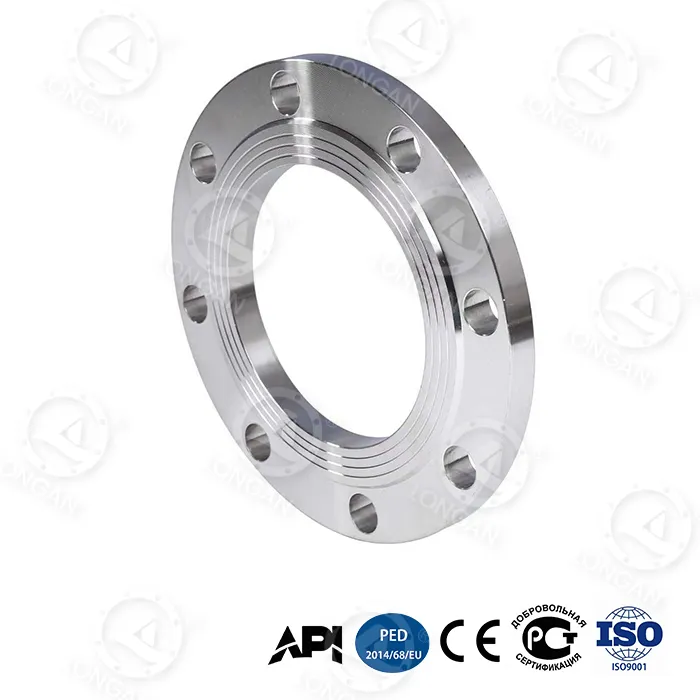
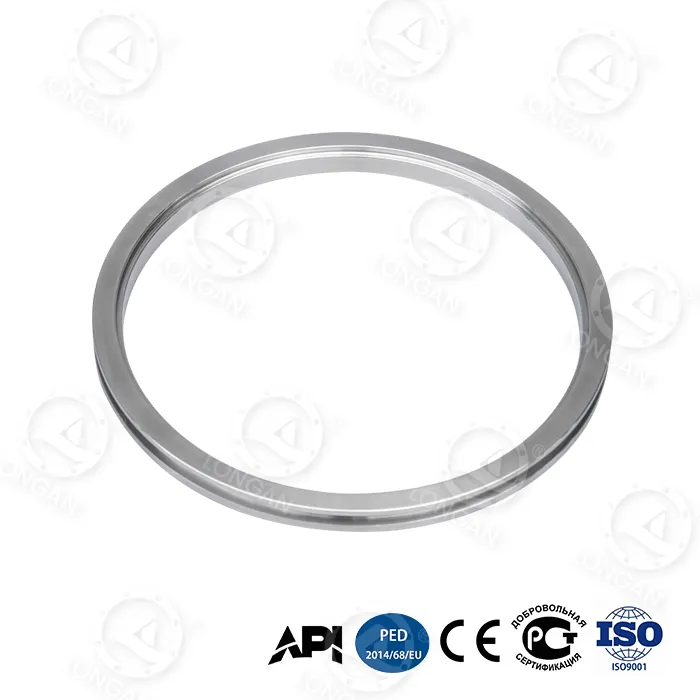
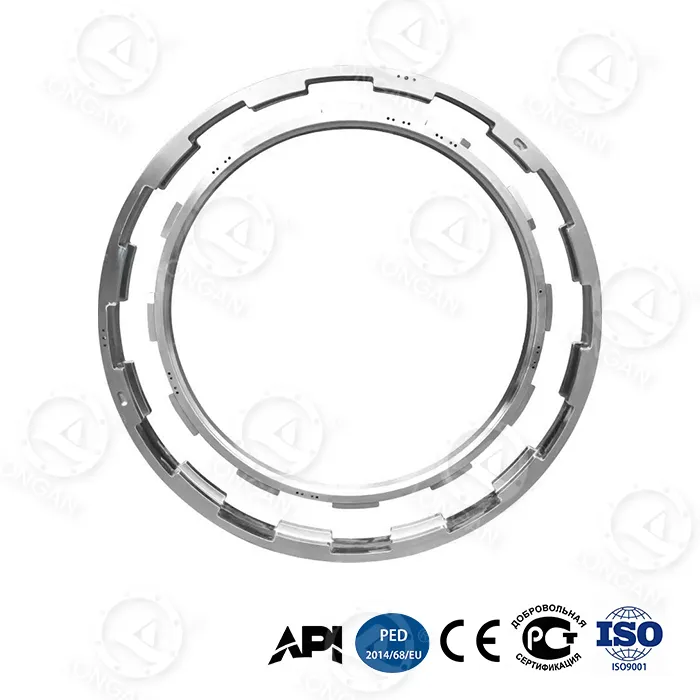
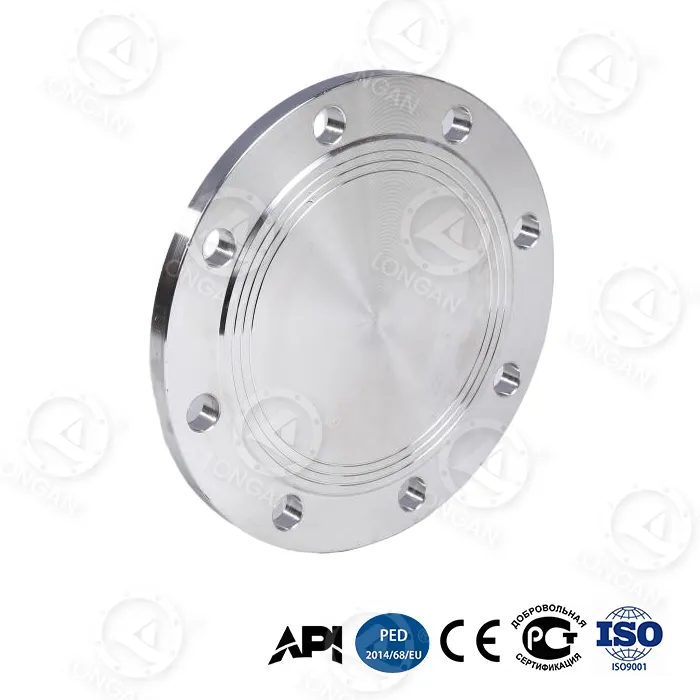
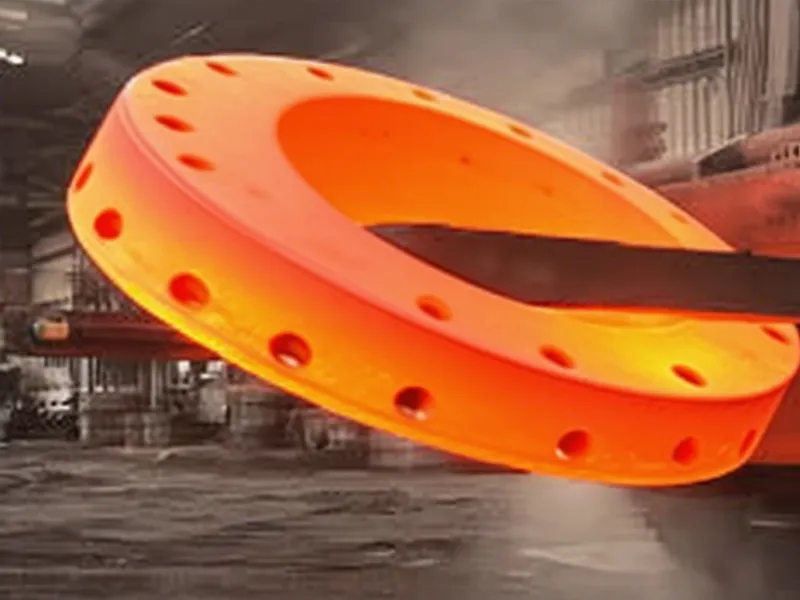
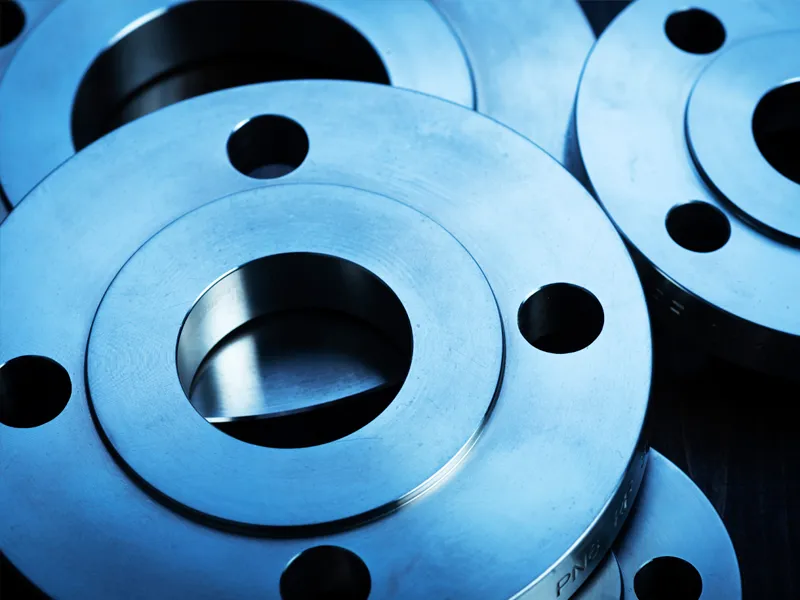
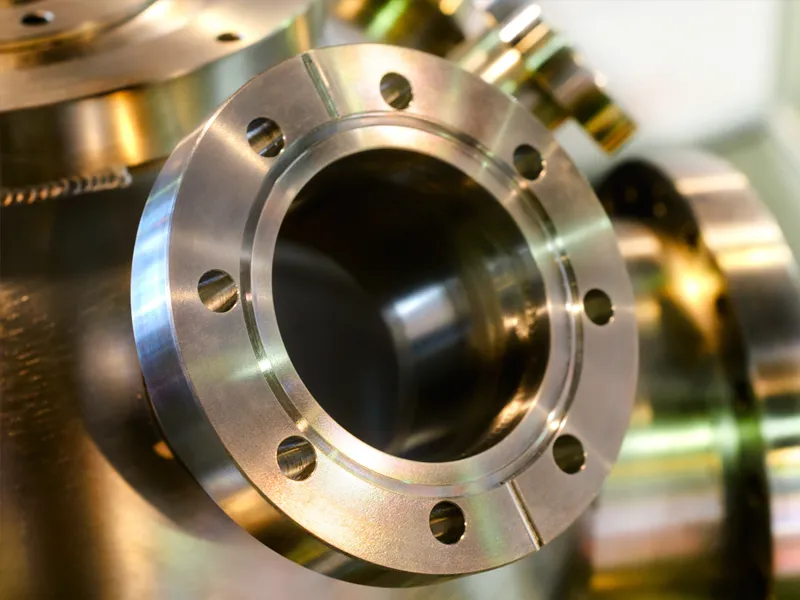
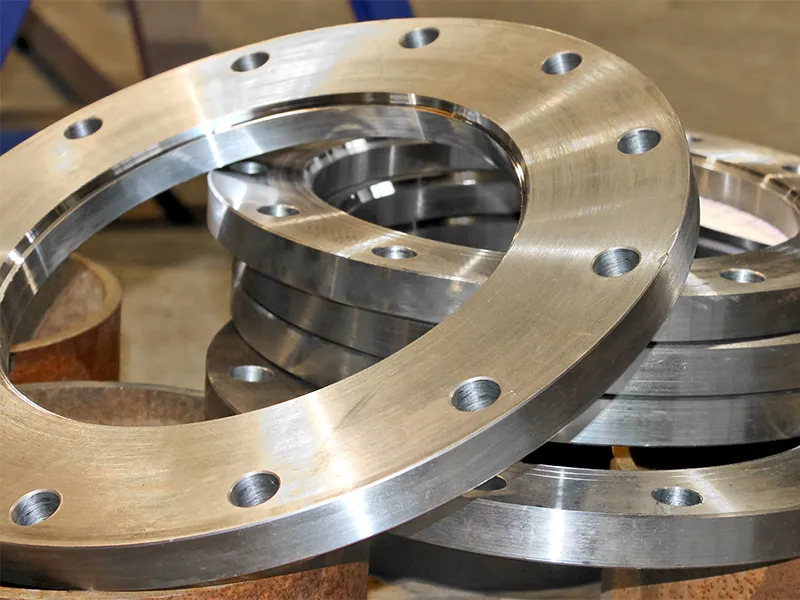
Petrochemical pipeline system preferred connector flat slip on flange, directly supplied by Chinese factory Longan, with customization services to meet special size requirements. The innovative double-weld structure reduces installation difficulty, and the built-in titanium alloy reinforcement ring achieves a yield strength of 1,250MPa. API 6A PSL 3G certification guarantees quality safety. One piece minimum order, fast delivery, serving global customers.
Longan, an experienced manufacturer and global supplier of flat slip on flange in China, has been serving international industrial pipeline projects for many years. The in-house factory implements strict quality management from raw materials to finished products, ensuring consistent quality and long-term reliability of each product. This flat face slip-on flange adopts a bionic honeycomb structure and gradient quenched high-carbon steel process, increasing bending resistance by 65% compared to traditional flanges. The DN300 burst pressure reaches 42MPa, exceeding the national standard GB/T 1048 by 280%, and it has passed API 6A PSL 3G certification. The following sections will comprehensively analyze the technical advantages and application value of this product from dimensions including installation welding, ultimate pressure bearing, off-load resistance, intelligent warning, extreme environment adaptability, applicable standards, and supply capacity.
Installation and Welding Advantages
As a slip-on type flange, flat slip on flange is connected to the pipe by two fillet welds during installation: one on the back of the flange and one inside the pipe bore. Compared with traditional weld neck flanges, this design has the following significant advantages:
1. Lower installation difficulty: No precise pipe alignment is required, allowing certain installation errors and reducing on-site construction requirements. 2. Convenient welding operation: Fillet welds are easier to execute than full penetration butt welds, especially suitable for confined spaces on site. 3. Fast replacement speed: Single replacement time is reduced from 8 hours for traditional flanges to 2.5 hours, effectively reducing pipeline system downtime for maintenance.
This slip-on structure, combined with Longan's unique bionic honeycomb lightweight design, further reduces the overall flange weight and improves installation efficiency.
Ultimate Pressure and Environmental Performance Comparison
Performance indicator
Traditional forged steel flange
flat slip on flange
Improvement
Burst pressure (DN300)
≤15MPa
42MPa
↑180%
Cyclic fatigue life (35MPa)
Not achievable
20,000 cycles
—
Axial deformation (35MPa)
1.8mm
0.6mm
↓67%
Impact energy at -70°C
≥34J (national standard)
89J
↑162%
30-year deep-sea corrosion rate
approx. 0.5mm/year
0.03mm/year
↓94%
This product fully surpasses traditional flanges in ultimate pressure bearing and environmental adaptability. The core breakthrough lies in the built-in titanium alloy reinforcement ring in the flange neck, with a yield strength of up to 1,250MPa, creating the possibility of ultra-high pressure applications for slip-on flanges.
Off-load Response
In actual pipeline systems, factors such as thermal expansion/contraction and foundation settlement often cause flange face misalignment. Under eccentric load conditions with a 15° pipeline misalignment, the sealing leakage rate of traditional flanges is >10⁻³ mbar·L/s, while Longan's flat slip on flange maintains a sealing leakage rate of ≤10⁻⁵ mbar·L/s, improving sealing reliability by two orders of magnitude.
Two structural innovations achieve this performance:
● Radial reinforcement rib design: Radial reinforcement ribs added on the back of the flange reduce local stress concentration by 48%, making stress distribution more uniform under off-load conditions. ● High-stiffness honeycomb structure: The bionic honeycomb core layer provides excellent bending stiffness, resisting flange face warping deformation.
In addition, in the ISO 10816-3 standard 50-200Hz frequency band vibration test, the amplitude attenuation rate reaches 92%, effectively solving the problem of bolt preload attenuation under high-pressure pulsation conditions.
Intelligent Warning and Extreme Environment
flat slip on flange integrates two intelligent technologies to help users detect potential issues early:
● Nano-zirconia wear indicator layer: This material is embedded in the sealing surface. When the thickness is less than 0.1mm, a visible color change gives a warning, allowing sealing status to be judged without professional equipment. ● Double-conical bolt hole preload locking: Under 35MPa pressure fluctuation, the preload attenuation of traditional structures is ≥20%, while this design controls preload attenuation within ≤5%, ensuring long-term connection reliability.
Extreme environment performance verification (all data from actual tests):
● Low-temperature impact (-70°C): Charpy impact energy of 89J (national standard ≥34J), suitable for polar pipelines and LNG transportation. ● Deep sea corrosion (5,000 meters): According to ASTM G111-97 standard, 30-year equivalent corrosion rate is only 0.03mm/year, meeting full life cycle requirements for deep-sea engineering. ● Sand and dust abrasion (120m/s): According to ISO 5890:2012 standard, after 10,000 hours of continuous impact, the sealing surface damage depth is ≤8μm, suitable for desert areas or offshore platforms with high-speed sand-laden winds.
Applicable Standards and Specifications
flat slip on flange is manufactured strictly in accordance with ASME B16.5 standard, with pressure ratings covering Class 150 to Class 1500, and size range from NPS 1/2 inch to 24 inches. The material is gradient quenched high-carbon steel, combined with radial reinforcement rib design and built-in titanium alloy reinforcement ring.
According to ASME B16.5 specification, the thickness measurement for Class 150 and Class 300 flanges does not include the raised face height. This product adopts a full-face (FF) sealing surface design and must be used with a full-face gasket. It is important to note that a full-face flange must not be directly bolted to a raised face flange; it must be replaced with a full-face gasket or an adapter.
Material Science and Process Innovation
● Gradient quenched high-carbon steel: Traditional full quenching of flanges results in excessive hardness differences between the surface and core, prone to cracking. Gradient quenching technology precisely controls heating and cooling rates, creating a gradual hardness distribution from outside to inside – high surface hardness for wear resistance, high core toughness for impact resistance. This allows the flange to maintain impact toughness of 89J at -70°C.
● Bionic honeycomb structure: Drawing inspiration from the hexagonal geometry of beehives, this structure significantly increases bending stiffness without increasing weight. Finite element analysis verifies that the bending strength of this structure is 65% higher than a solid flange of the same weight.
● Built-in titanium alloy reinforcement ring: A Ti-6Al-4V titanium alloy ring is pre-placed at the flange neck, the location most prone to stress concentration. This alloy has a yield strength as high as 1,250MPa and a density only 60% that of steel. The ring is bonded to the base material through interference fit, effectively limiting neck plastic deformation and increasing the DN300 flange burst pressure from the traditional ≤15MPa to 42MPa.
Production and Quality Inspection System
Longan's in-house factory is located in Longwan, Wenzhou. Leveraging the high-quality raw material supply from Tsingshan Holding Group, combined with its own forging, heat treatment, and machining capabilities, it has formed a complete production chain. Each flat slip on flange comes with traceable material certificates, heat treatment curve records, dimensional inspection reports, and hydrostatic/pneumatic test reports.
Quality control key points:
1. Raw material incoming inspection: spectral analysis, mechanical property sampling. 2. Process control: real-time monitoring of heat treatment furnace temperature curves, automatic recording of gradient quenching process parameters. 3. Finished product inspection: 100% dimensional inspection, 10% magnetic particle testing, batch sampling for burst pressure or cyclic fatigue life. 4. Third-party witnessing: On-site witness testing by SGS, BV, or other agencies can be arranged upon customer request.
International buyers can check production progress and test data online using the order number.
Global Project Application Cases
● Middle East shale gas field fracturing station: 120 sets of DN300 Class 1500 flat slip on flange were used. After 18 months of continuous operation, no seal leakage occurred, and maintenance frequency was zero. ● South China Sea deep-sea drilling platform: Water depth 2,800 meters. The flange was used to connect the blowout preventer stack. After 30 months of corrosion inspection, the sealing surface showed no obvious damage, and the measured corrosion rate was 0.028mm/year. ● Russian Arctic natural gas pipeline: Ambient temperature -55°C, impact test value 82J, meeting project design requirements. Over 500 pieces have been supplied.
FAQ
Q: What pressure ratings is it suitable for?
A: This flat slip on flange is suitable for pressure ratings from Class 150 to Class 1500. Measured data shows that the DN300 size performs excellently at a burst pressure of 42MPa, far exceeding national standard requirements. It is particularly suitable for ultra-high pressure and harsh conditions such as shale gas fracturing pumps, deep-sea drilling platforms, ultra-high pressure natural gas transmission pipelines, and polar environments.
Q: What is the main difference between this and a weld neck flange?
A: A slip-on flange uses two fillet welds to connect the pipe (one on the back and one inside the bore), with relatively relaxed installation requirements. A weld neck flange uses a single full-penetration butt weld, requiring stricter alignment. However, in Longan's slip-on flange product, through the design of bionic honeycomb structure and built-in titanium alloy reinforcement ring, the pressure bearing performance is no less than that of traditional weld neck flanges.
Q: How does it perform in low-temperature environments?
A: Under ultra-low temperature conditions of -70°C, the product's Charpy impact energy reaches 89J, far higher than the national standard requirement of ≥34J. This is thanks to the excellent low-temperature toughness of the gradient quenched high-carbon steel material, making it suitable for polar pipeline engineering and low-temperature natural gas transportation systems.
Q: What are Longan's supply capacity and customization options?
A: Longan has an in-house factory and a complete production system, supporting size customization, private labeling, and bulk production. Strict quality management is implemented from raw material selection to finished product inspection. International buyers can send requirements to obtain free samples. The company is located at No. 620 Mingzhu Road, Yongxing Street, Longwan District, Wenzhou City, Zhejiang Province, leveraging Wenzhou's geographical advantages and Tsingshan Holding Group's raw material supply to form a complete production and supply system.
Q: How can the actual performance be verified?
A: Longan welcomes customers or third-party inspection agencies to witness performance tests at the factory. The factory is equipped with a 3000-ton pressure testing machine, a cyclic fatigue test bench, a -80°C low-temperature impact tester, and a deep-sea high-pressure corrosion simulation chamber. Customers can request burst pressure tests, cyclic fatigue tests, or extreme environment tests on samples; test reports are issued by an internal laboratory with CNAS qualifications.
For inquiries about Socket Flange, Flat Flange, 304 Welding Flange or price list, please leave your email to us and we will be in touch within 24 hours.
We use cookies to offer you a better browsing experience, analyze site traffic and personalize content. By using this site, you agree to our use of cookies.
Privacy Policy